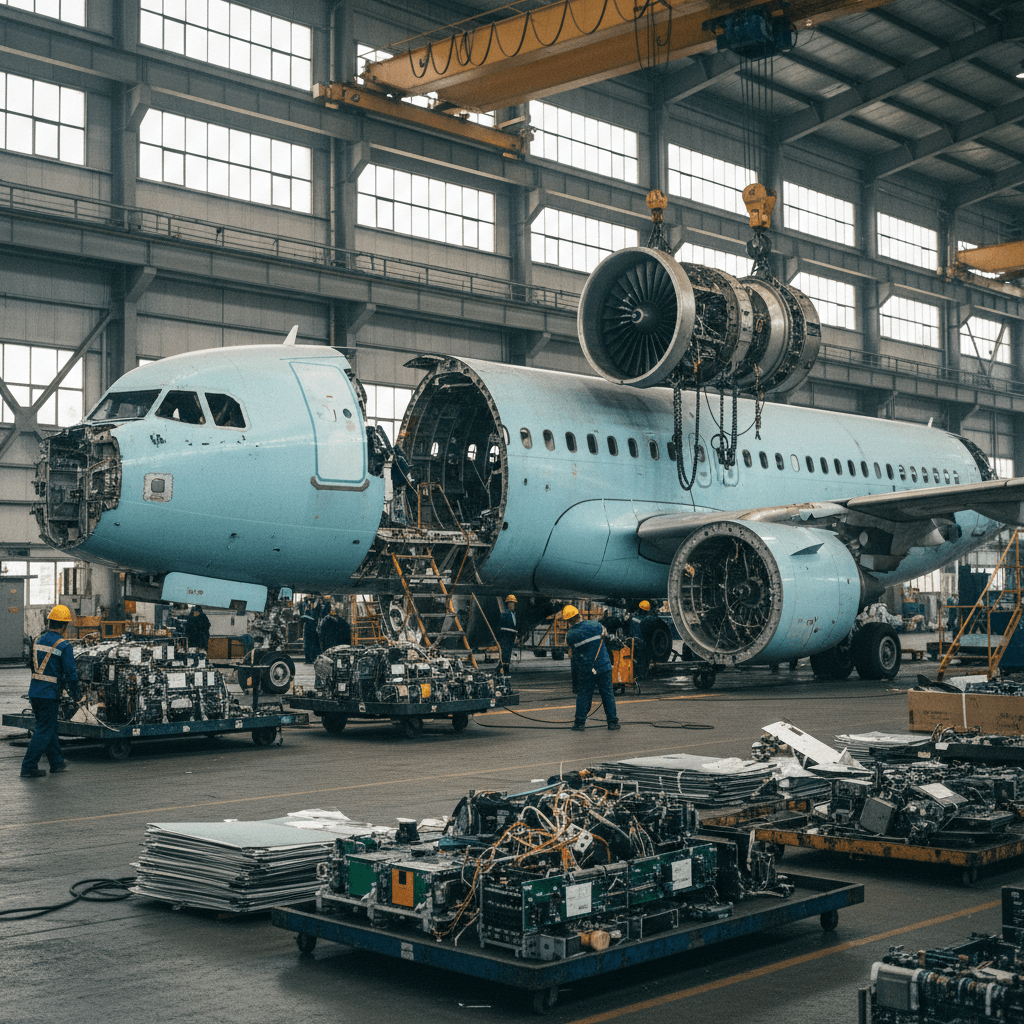
Workers dismantle an Airbus aircraft in a vast hangar, preparing components for recycling.
The aircraft recycling industry is projected to reach a market valuation of $7.66 billion by 2030, demonstrating a compound annual growth rate of 7.2%. According to openPR.com, this expansion is primarily driven by the anticipated increase in retirements of next-generation aircraft, a growing commitment to sustainability, and advancements in material recovery techniques, particularly for aluminum and titanium.
Key trends include the increased use of recycled aerospace-grade aluminum and titanium, adoption of non-destructive dismantling methods, and expansion of services for end-of-life aircraft globally. Market leaders such as Aircraft Solutions USA, AELS, Aviation International Recycling LLC, and GA Telesis LLC are dominating the sector. Unical Aviation’s acquisition of ecube Solutions in September 2024 is a strategic move to enhance service capabilities across Europe, the Middle East, and Africa (EMEA).
Technological innovations are central to market players’ strategies. Airbus launched its first global aircraft recycling initiative, the Airbus Lifecycle Services Centre (ALSC) in Chengdu, China, in January 2024. With an investment of 6 billion yuan (approximately $844.55 million), the ALSC aims to enhance aircraft component recycling rates, targeting over 90% eco-friendly recycling by weight. The ALSC, which began dismantling its first aircraft in August 2024, collaborates with Airbus China R&D and Innovation Centre and Hengri Corporation to focus on material recovery and reuse, offering maintenance, upgrades, and controlled distribution of reusable parts.
The aircraft recycling market is segmented by product categories (Engines, Landing Gear, Avionics), material types (Aluminum, Other Metals and Alloys), and aircraft classifications (Narrow-Body, Wide-Body, Regional). These segments are further divided into sub-segments like Turbine Engines, Piston Engines, Main Landing Gear Assemblies, Nose Landing Gear Assemblies, Communication Systems, Navigation Systems, Flight Control Systems, and Monitoring and Display Systems, reflecting the diverse components and materials involved.
About the Author