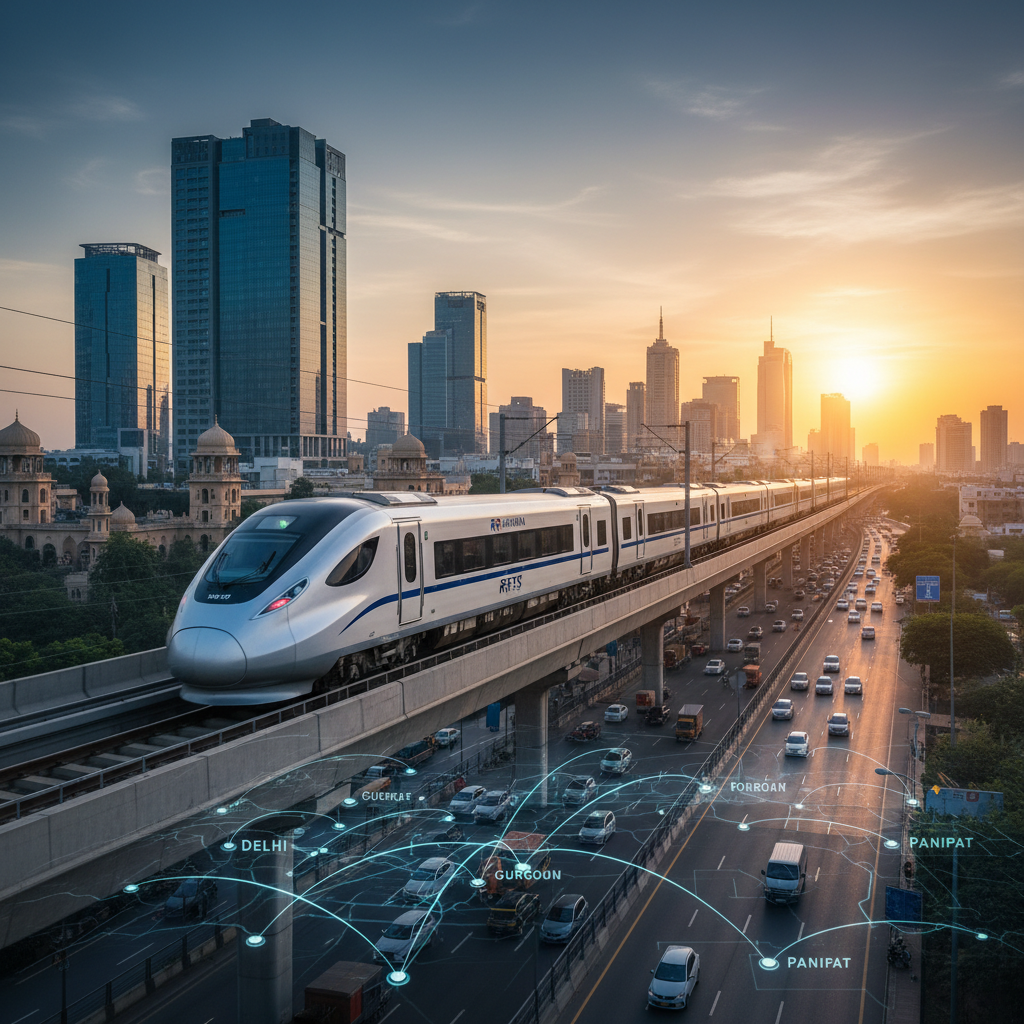
Haryana Clears Path for High-Speed RRTS Corridor
In a significant step towards enhancing regional connectivity and easing congestion, Haryana’s Chief Minister Nayab Singh Saini has approved the final alignment for the Gurugram-Faridabad-Noida-Greater Noida Namo Bharat RRTS-cum-Metro Corridor. This decision marks a pivotal moment for the state’s infrastructure development, promising to transform the way people travel within the region and beyond. The project, spanning 64 km, with over 52 km within Haryana, is poised to connect key economic hubs, thereby fostering economic growth and improving the quality of life for residents.
Key Highlights of the RRTS Corridor
The ambitious RRTS project aims to provide high-speed travel options, significantly reducing travel times between major cities and towns. The integration with existing metro networks is a crucial aspect of the plan, ensuring seamless connectivity and offering commuters a convenient and efficient mode of transportation. This integration is designed to streamline the commute for residents, reducing the reliance on private vehicles and, consequently, mitigating traffic congestion. The project’s primary goal is to connect key economic hubs, making it easier for people to access employment opportunities, educational institutions, and other essential services.
Strategic Importance for Haryana
The strategic placement of this RRTS corridor within Haryana underscores its significance in the state’s infrastructure vision. The project is not merely about transportation; it’s about fostering economic development and improving regional integration. By connecting cities like Gurugram and Faridabad, the corridor will facilitate the movement of goods and people, boosting economic activities and creating new opportunities for businesses. The implementation of this project is a testament to the government’s commitment to improving the state’s transportation infrastructure, with the goal of making it more efficient and sustainable. The project will also improve the quality of life for residents by reducing commute times and providing a reliable public transportation system.
Benefits and Impact
The Gurugram-Faridabad-Noida-Greater Noida Namo Bharat RRTS corridor is expected to bring several benefits to the region. High-speed travel will allow people to travel between cities more quickly, saving valuable time and increasing productivity. The integration with existing metro networks will provide a seamless and integrated public transportation system, encouraging more people to use public transport. The project is also expected to reduce traffic congestion, leading to cleaner air and a better environment. Furthermore, the corridor will boost economic activities by connecting key economic hubs, making it easier for businesses to operate and grow.
Conclusion
The Haryana government’s approval of the Gurugram-Faridabad-Noida-Greater Noida Namo Bharat RRTS corridor represents a significant step towards modernizing the state’s infrastructure and enhancing regional connectivity. Under the leadership of Chief Minister Nayab Singh Saini, the project is set to transform the transportation landscape, offering high-speed travel, reducing congestion, and connecting key economic hubs. This initiative is a clear indication of Haryana’s commitment to sustainable development and improved quality of life for its residents.
Source: Industry-Economic Times
About the Author