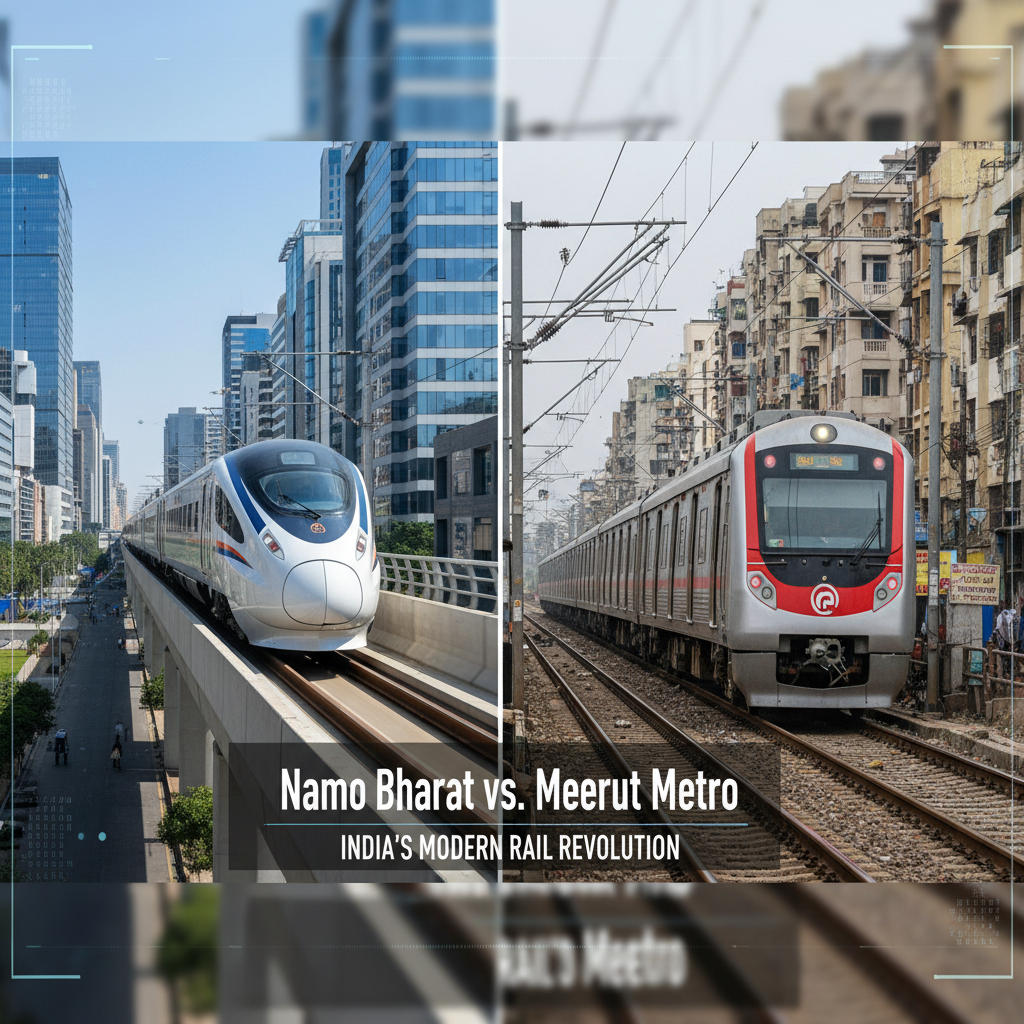
Namo Bharat vs. Meerut Metro: Key Differences in Speed, Route, and Purpose Explained
India is witnessing a significant transformation in its public transportation landscape, spearheaded by the introduction of the Meerut Metro and the Namo Bharat train. This initiative, launched by Prime Minister Narendra Modi, represents a major leap forward in integrating high-speed regional transit with intra-city metro services. The project is designed to enhance connectivity between Delhi and Meerut, aiming to drastically reduce travel times and alleviate traffic congestion. This article delves into the key differences between these two vital components of India’s modern rail network, offering a comprehensive understanding of their roles and functionalities.
Understanding the Namo Bharat Train
The Namo Bharat train is a high-speed regional transit system designed to connect Delhi and Meerut. It is engineered to cover longer distances at higher speeds, making it ideal for regional travel. The primary objective of the Namo Bharat is to facilitate faster and more efficient movement between cities, thereby reducing commute times for a large number of passengers. The system operates on shared infrastructure, optimizing the utilization of resources and ensuring seamless connectivity across the region.
Exploring the Meerut Metro
In contrast to the Namo Bharat, the Meerut Metro focuses on intra-city transportation within Meerut. It is designed to cater to the specific needs of urban commuters, providing a reliable and efficient mode of transport within the city limits. The Meerut Metro operates on the same integrated infrastructure as the Namo Bharat, offering a cohesive network for commuters. This integration ensures a smooth transition between regional and local transit, enhancing the overall commuting experience.
Key Differences: Speed, Route, and Purpose
Speed
The Namo Bharat train is built for high-speed regional transit, enabling it to achieve significantly higher speeds compared to the Meerut Metro. This difference in speed is crucial for covering longer distances efficiently. The Meerut Metro, designed for intra-city travel, prioritizes frequent stops and accessibility within the city, which influences its operational speed.
Route
The routes of the Namo Bharat and Meerut Metro are strategically planned to complement each other. The Namo Bharat connects Delhi and Meerut, while the Meerut Metro operates within Meerut. This integrated approach ensures that commuters can easily switch between regional and local transit, providing a comprehensive transportation solution. The shared infrastructure facilitates seamless connectivity, making travel more convenient and time-efficient.
Purpose
The primary purpose of the Namo Bharat is to reduce travel times between Delhi and Meerut, easing traffic congestion and promoting regional connectivity. The Meerut Metro, on the other hand, aims to improve intra-city mobility, providing a sustainable and efficient mode of transport for urban residents. Both systems collectively contribute to a more integrated and efficient public transportation network, aligning with the broader goals of modernizing India’s infrastructure.
The Significance of the Integrated System
The integration of the Namo Bharat and Meerut Metro on shared infrastructure is a strategic move, designed to optimize resources and enhance the overall efficiency of the public transportation system. This integrated approach allows for seamless transfers between regional and local transit, improving the commuting experience for passengers. By combining high-speed regional transit with intra-city metro services, the project not only reduces travel times but also plays a vital role in easing traffic congestion, contributing to the sustainable development of the region.
Conclusion
The launch of the Meerut Metro and Namo Bharat train, under the leadership of Prime Minister Narendra Modi, marks a significant milestone in the evolution of India’s modern rail network. These systems, designed to serve different but complementary purposes, are set to transform the way people travel between Delhi and Meerut. By understanding the key differences in their speed, route, and purpose, commuters and policymakers alike can better appreciate the impact of these initiatives on regional connectivity and urban mobility. This integrated approach not only enhances the efficiency of public transportation but also supports the broader goals of sustainable development and improved quality of life for residents in the Delhi-Meerut region.
About the Author