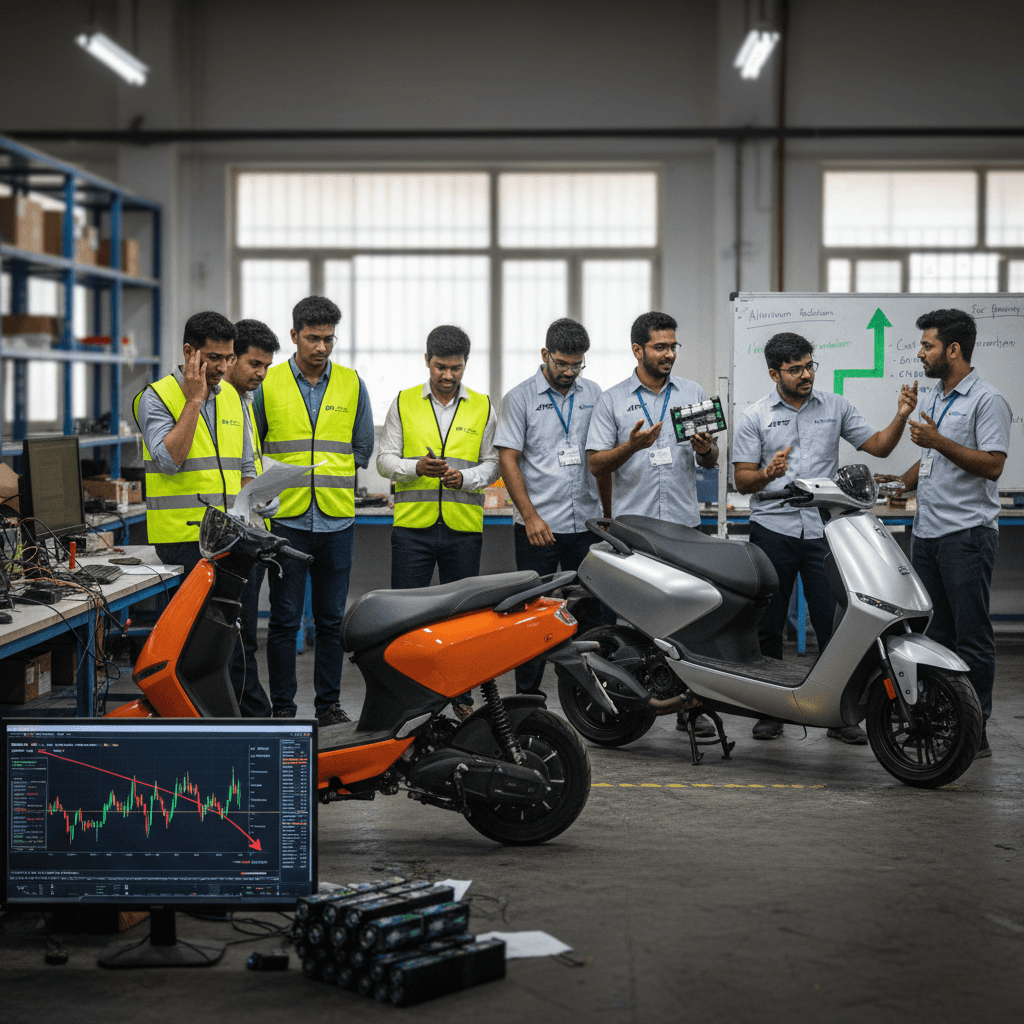
Engineers at a manufacturing facility discussing electric scooter components amidst market data.
Shares of Ola Electric experienced a downturn, falling 7.79% to an intraday low of ₹37.71 on the BSE, following a broader market decline influenced by stalled negotiations between the US and Iran. At 13:45 IST, the stock was trading 6.97% lower at ₹38.05, with a market capitalization of ₹16,783 Cr (approximately $1.8 Bn).
Despite the recent dip, Ola Electric’s stock has surged 61% in April, including a nearly 20% jump on April 9 after announcing its in-house developed 46100 Lithium Iron Phosphate (LFP) cell is ready. This development marks a step towards vertical integration and cost-efficient EV manufacturing. The new cell is expected to be integrated into Ola Electric’s products from Q2 FY27.
Ola Electric is also increasing its Gigafactory’s capacity to 6 GWh from 2.5 GWh. March sales figures showed improvement, with registrations jumping over 150% MoM to 10,117 units. The company also secured Production Linked Incentive (PLI) certification for its ebike Roadster X+ 4.5 kWh, making it eligible for government incentives.
Conversely, Ather Energy’s stock surged 9.84% to an all-time high at ₹948.45 intraday, trading over 8% higher at ₹932.90 at 13:45. This rally is attributed to the company’s efforts to reduce aluminum usage in response to rising aluminum prices due to geopolitical factors such as potential Strait of Hormuz closures. Ather Energy aims to increase the intake of recycled aluminum and reduce overall aluminum usage, targeting a 15% reduction in engineering costs for its upcoming EL platform.
Cofounder and CTO Swapnil Jain noted that while some models have high aluminum usage for performance, the surge in aluminum prices has increased manufacturing costs. The shift aims to balance performance with cost efficiency, focusing on family-oriented vehicles.
About the Author