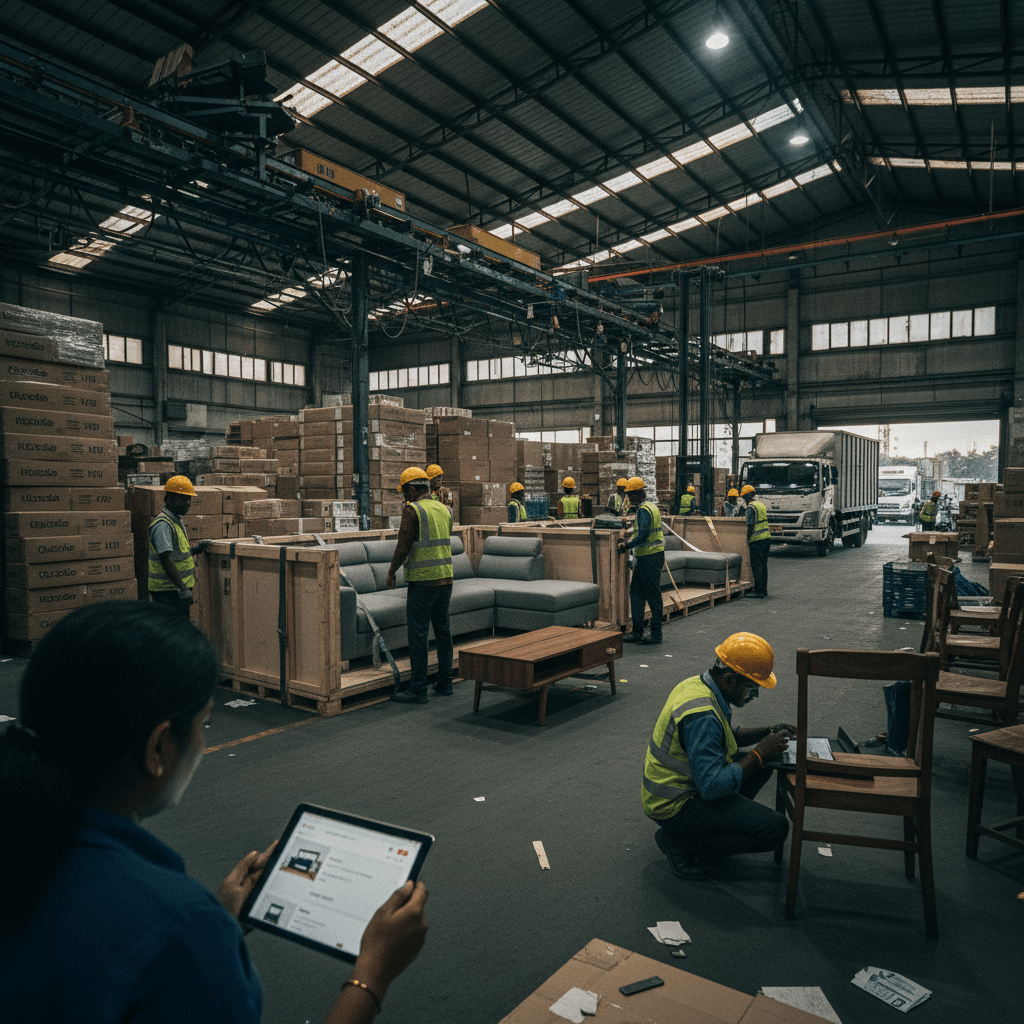
Workers organize furniture in a large Indian warehouse as a woman uses a tablet for inventory.
India’s furniture ecommerce sector is transitioning from experimentation to consolidation, evidenced by recent IPO filings and strategic acquisitions. Wakefit’s public offering of ₹1,288.89 Cr and Rentomojo’s DRHP filing to raise ₹150 Cr indicate a maturing market. Duroflex’s Sleepyhead brand is also nearing a public listing.
Pepperfry’s acquisition by TCC Concept for ₹662 Cr signals a market correction for high-growth players, while Furlenco’s $125 Mn fundraise demonstrates continued investor interest in efficient, demand-driven models. IKEA has committed over $2 Bn to India, and Godrej Interio is expanding its omnichannel presence.
Despite online penetration growing to 10-15% post-pandemic, the market remains largely unorganized, with projections exceeding $44 Bn by 2034. Ajith Mohan Karimpana, founder and CEO of Furlenco, noted the potential for more branded furniture players to list on the bourses.
Analysts cite evolving customer preferences as a key growth driver, with consumers prioritizing design, functionality, and overall experience. Wakefit’s cofounder, Chaitanya Ramalingegowda, mentioned increasing interest in tech-integrated products. Consumers research and browse online but still value physical stores for validation, necessitating seamless omnichannel integration.
Logistics remains a challenge, with third-party providers often ill-equipped to handle large furniture shipments, increasing the risk of damage. Dhruvan Barar, cofounder of Delhi NCR-based Boingg, highlighted that even minor defects can impact customer satisfaction. Longer delivery timelines add friction in a market with high expectations.
Furlenco’s Karimpana believes customer experience is critical, emphasizing order management, on-time deliveries, and product quality. Lifecycle services like assembly, maintenance, and resale are becoming meaningful revenue drivers. Rentomojo’s ₹61 Cr profit in H1 FY26 underscores the viability of rental and subscription models.
Lokendra Singh Rawat, founder of WoodenStreet, suggests tracking evolving home needs to drive repeat engagement in this low-frequency category, tapping into transition phases and expanding into related categories like décor and storage solutions.
About the Author