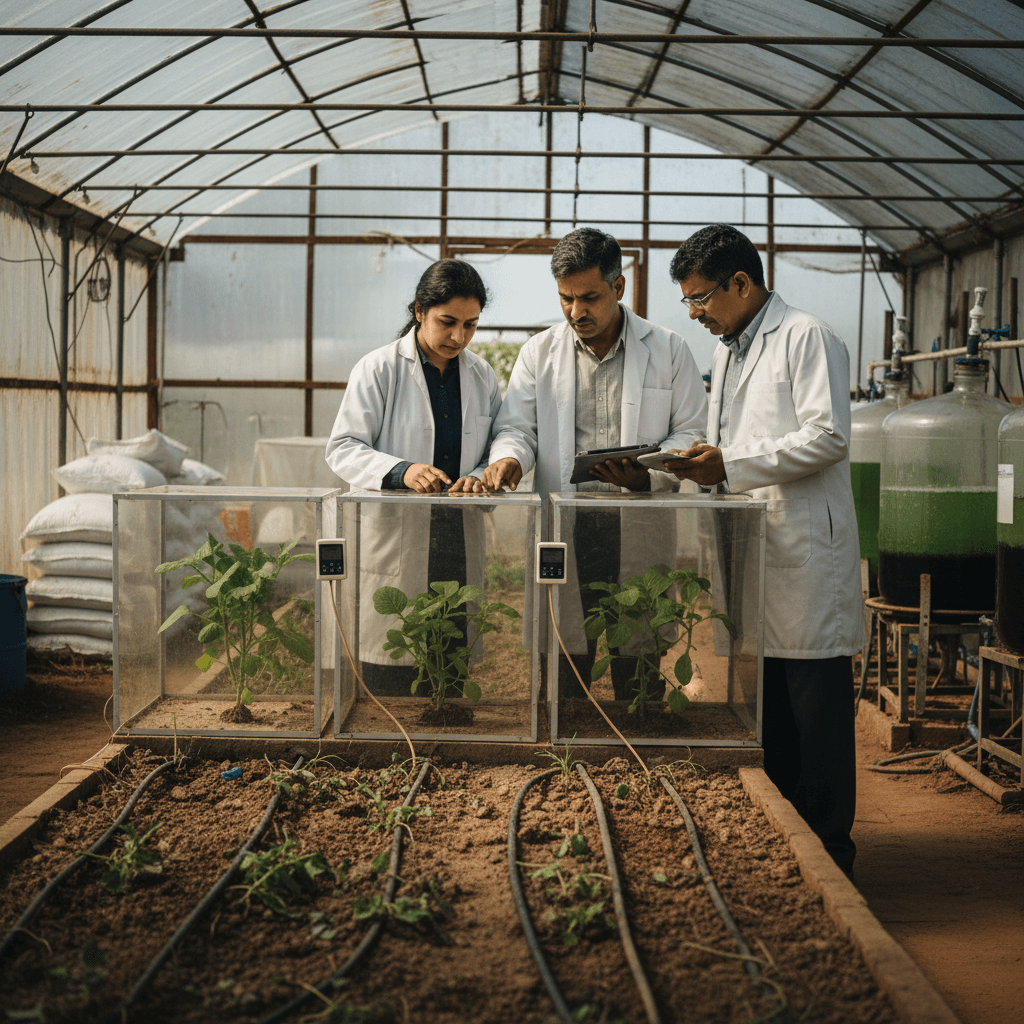
Scientists in a greenhouse monitoring plants in controlled environments, symbolizing agricultural innovation.
Indian farms are increasingly vulnerable to weather volatility, with erratic monsoons, prolonged heatwaves, and unseasonal cold spells becoming more frequent. Farmers are seeking actionable solutions to protect their crops from these adversities.
This demand is driving growth in India’s biofertilizer market, which is projected to reach $253.09 million by 2031, and the biostimulants market, expected to scale to $365.38 million in the same period. Policy support, rising fertilizer costs, and global demand for residue-free produce are contributing to the adoption of biological inputs.
BioPrime, a Pune-based firm founded by Dr. Renuka Diwan, Dr. Amit Shinde, and Dr. Shekhar Bhosle, aims to address these challenges by developing biological agri inputs. These inputs, including sprays and irrigation additives, utilize biochemicals and microbes to help crops withstand climatic stress while improving yield quality and soil health.
BioPrime works with secondary metabolites, compounds that plants naturally produce for defense, such as alkaloids, terpenes, amines, glucosinolates, quinones, phenolics, and peptides. These metabolites are used to prime crops in advance, enabling them to better survive adverse conditions.
The company has developed a patented tech stack, comprising SNIPR (biomolecules) and BioNexus (microbes), to provide immediate protection from adverse weather conditions and long-term soil health benefits, while reducing dependence on chemical fertilizers. BioPrime also offers soil restoration inputs and biological crop protection products, such as bio-insecticides and bio-fungicides.
According to Diwan, BioPrime has experienced three-fold year-on-year growth and is focused on achieving profitability in the coming year, with plans for international expansion. The company has raised $8 million in funding, including a $6 million Series A round led by Edaphon, with participation from Omnivore and Inflexor Ventures. BioPrime has also partnered with global and domestic agri-input majors, including Yara, ICL Fertilizers, DCM Shriram, and Insecticides India, expanding its presence across markets such as the US, Brazil, and Southeast Asia.
The cofounders of BioPrime recognized the limitations of existing agri-input solutions and the lack of effective tools to help farmers tackle climate-induced stress. This led to the establishment of BioPrime in 2016, with support from Pune’s Venture Center and government-backed grants.
Initially, the company faced skepticism from farmers. However, after demonstrating the effectiveness of its products on a farmer’s weakest crops, BioPrime gained credibility through word-of-mouth adoption. The company set up demo farms to showcase the benefits of its solutions through live harvests and yield calculations.
BioPrime has diversified its product formats to include sprayable and granule-based applications, making them suitable for various regions. The company has also expanded its focus beyond single-problem solutions, adopting a platform approach to address multiple use cases, from stress tolerance to nutrient efficiency and crop protection.
BioPrime’s platform combines biomolecules and microbes for immediate and long-term results. The SNIPR platform identifies and extracts natural defense signals from plants, algae, and microorganisms, while BioNexus is a microbial platform designed to restore the natural microbial ecosystem that supports plant growth.
BioPrime aims to partner with the broader agri-input ecosystem, positioning itself as a collaborator rather than a competitor. The company is focused on international expansion, navigating regulatory approvals to scale its presence in global markets. BioPrime’s goal is to establish a ‘Made in India, Made for the World’ biological brand.
The company is investing in regulatory expansion and IP development, with the aim of achieving profitability while continuing to invest in long-term capabilities. BioPrime has expanded its infrastructure, including R&D and production facilities, and is focused on building resilient agricultural systems with biology at the center of this shift.
About the Author