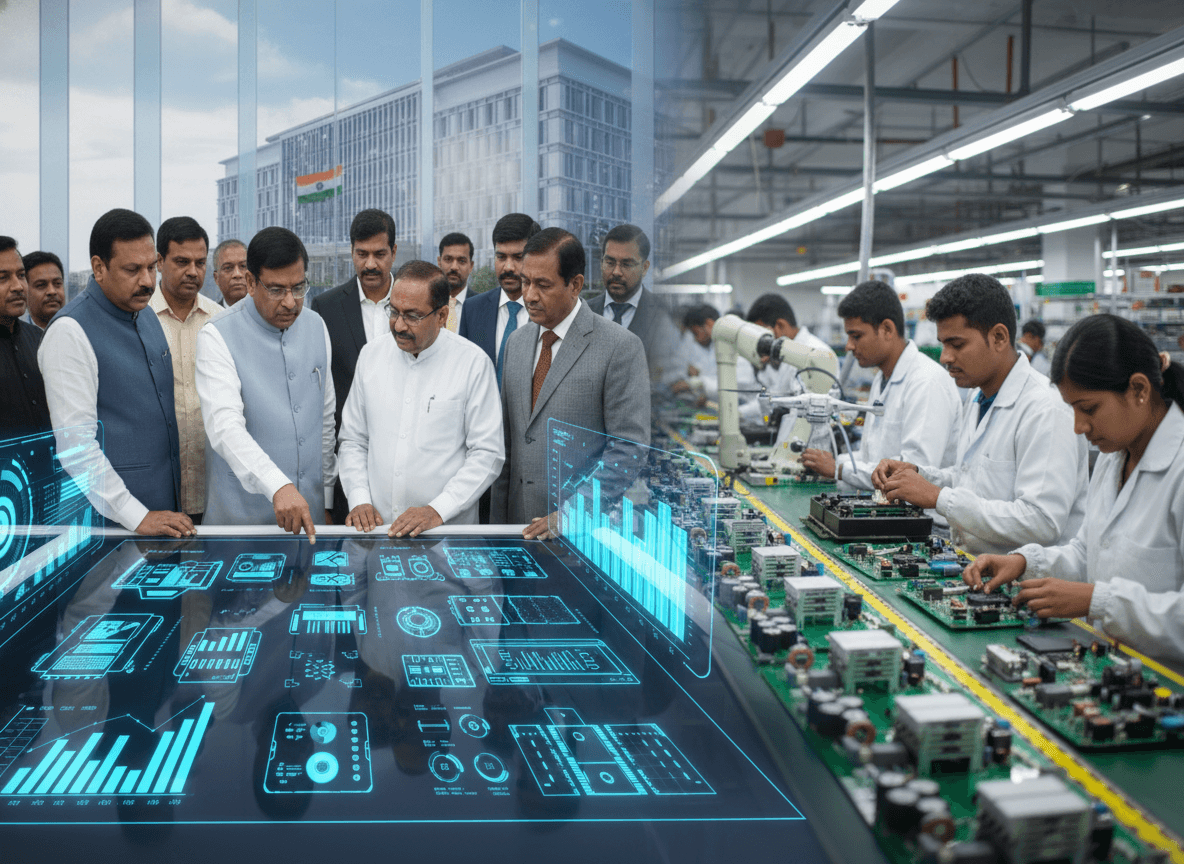
Indian officials reviewing electronics manufacturing data with a factory in the background.
India’s IT ministry (MeitY) has approved 29 additional electronics manufacturing projects under the Electronics Component Manufacturing Scheme (ECMS), totaling ₹7,104 Cr ($850 million USD). These projects are projected to generate 14,246 direct jobs and an estimated ₹84,515 Cr in production.
The approvals bring the total number of projects cleared under the ECMS to 75, with a total projected investment of ₹61,671 Cr and an estimated 65,040 direct employment opportunities. Approved projects span 16 product categories, including display modules, capacitors, connectors, resistors, flexible PCBs, and lithium-ion cells, which are used across sectors such as mobile manufacturing, telecom, consumer electronics, automotive, and IT hardware.
The approved projects include manufacturing units for SMD passive components based on tantalum capacitors, flexible printed circuit boards, and rare earth permanent magnets. Companies receiving approvals include Dixon Display Technologies, VVDN Technologies, Molex India, Vishay Components India, TDK India, and Syrma Strategic Electronics.
India also cleared proposals to strengthen supply chains for electronics components, including projects for copper clad laminates, metallised films for capacitors, and rare earth magnets. Lohum Cleantech will establish a rare earth magnet facility under ECMS. Six firms, including Titan Engineering and Automation, ASM Technologies, and Bharat FIH, received approvals to manufacture capital equipment.
IT minister Ashwini Vaishnaw emphasized the need for India to focus on building in-house design capabilities and a stronger domestic supply chain. MeitY secretary S Krishnan said the government expects companies to match the pace of approvals with execution.
The India Cellular and Electronics Association lauded the approvals, stating that the increased outlay of ₹40,000 Cr for the ECMS, along with the performance of the PLI scheme, could accelerate growth in the electronics manufacturing sector. The higher outlay was announced by finance minister Nirmala Sitharaman in the Union Budget 2026. The revised corpus is 75% higher than the earlier ₹22,919 Cr.
Launched in April 2025, the ECMS aims to build a $500 Bn electronics component manufacturing ecosystem in India by FY32, offering incentives linked to turnover, capital expenditure, and employment. In October 2025, the government said it received investment proposals of ₹1.15 Lakh Cr under the scheme, nearly double its original target of ₹59,350 Cr, with production estimates of ₹10.34 Lakh Cr against a target of ₹4.5 Lakh Cr.
About the Author