Flipkart's quick commerce strategy for IPO success.
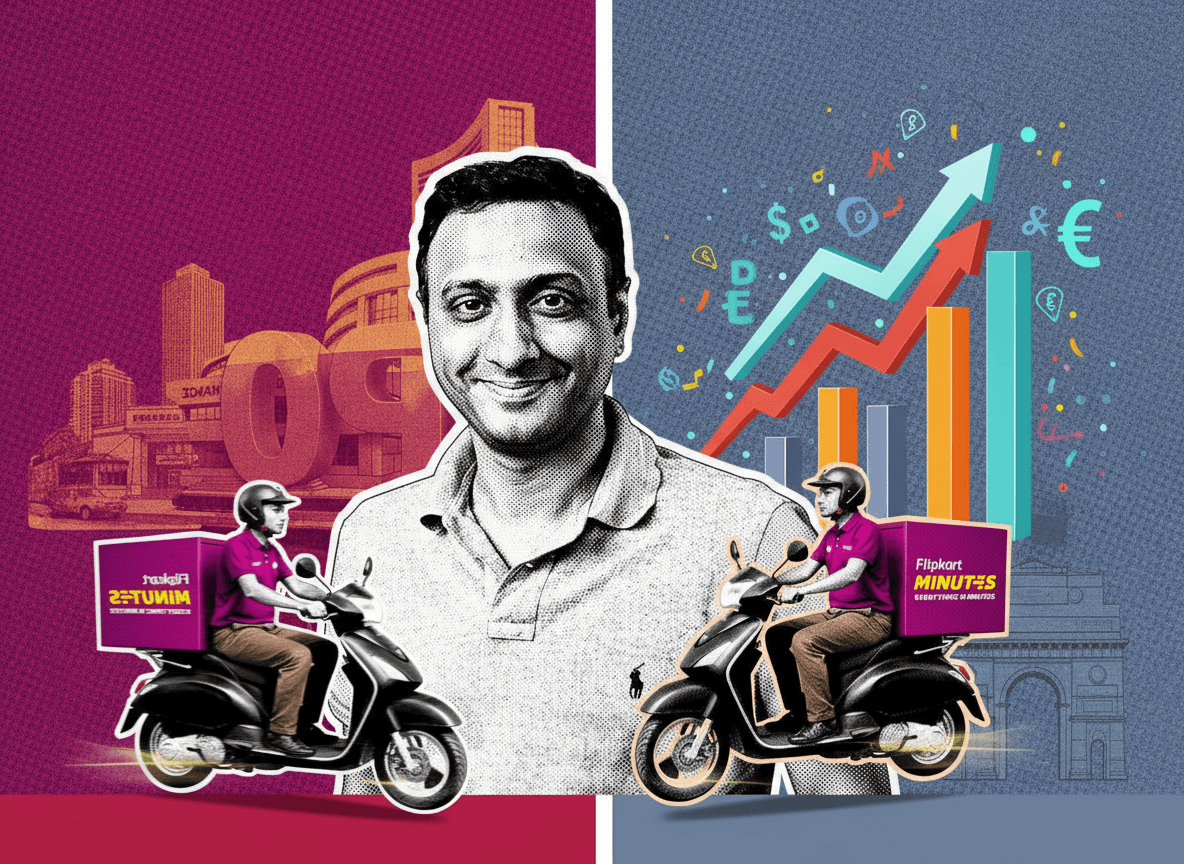
Flipkart is strategically aligning itself for a potential IPO, signaling readiness despite current market slowdowns. A key element of its pitch is Flipkart Minutes, its quick commerce gateway, which could serve as a critical differentiator for investors.
Public market investors are increasingly focused on high-frequency, high-retention categories like those offered by quick commerce. This trend is evident in the positioning of companies like Swiggy (Instamart) and Zomato (Blinkit), where quick commerce has become a primary growth driver.
Flipkart’s entry into quick commerce comes as the sector is projected to grow from $6.1 billion in 2024 to $40 billion by 2030, tapping into India’s massive $500 billion grocery market.
Launched in August 2024, Flipkart Minutes is rapidly expanding. While it initially aimed for 800 dark stores by the end of 2025 but reached approximately 500, its expansion has since accelerated. By early 2026, it scaled to 800 dark stores and is on track to reach 1,200, targeting 250 cities by June 2026, adding 100 dark stores monthly.
Average daily orders per dark store have doubled year-on-year, reaching about 1,100 orders, indicating improved throughput. Flipkart Minutes’ average order value (AOV) ranges between INR 750 and INR 800, surpassing competitors like Swiggy Instamart (INR 746), Blinkit (INR 547), and Zepto (approximately INR 410).
AOV is driven by strong traction in higher-value categories like smartphones, leveraging Flipkart’s established consumer trust in electronics. While Flipkart Minutes lags in net order volume, its higher AOV may improve contribution margins.
Flipkart benefits from its extensive ecommerce supply chain network built over a decade, including over 100 fulfillment centers spanning 3.5 million sq ft and serving over 21,000 pincodes nationwide. This existing infrastructure reduces capex requirements compared to pure-play quick commerce startups and enables faster expansion into tier II and tier III cities.
Non-metro cities contribute an estimated 25%-30% of Flipkart Minutes’ revenue, showing traction beyond top metros. Flipkart’s data on consumer behavior and purchasing patterns allows for precise inventory planning and demand forecasting.
Despite its momentum, Flipkart Minutes faces challenges. It lags behind incumbents in scale and operational maturity, requiring sustained capital deployment and increasing cash burn. Brand positioning is another key gap, needing significant marketing investments to establish recall.
The competitive landscape is intensifying with Amazon scaling Amazon Now and Reliance expanding JioMart’s capabilities. Flipkart Minutes is competing against established quick commerce leaders and new entrants with significant capital and ecosystem advantages.
About the Author