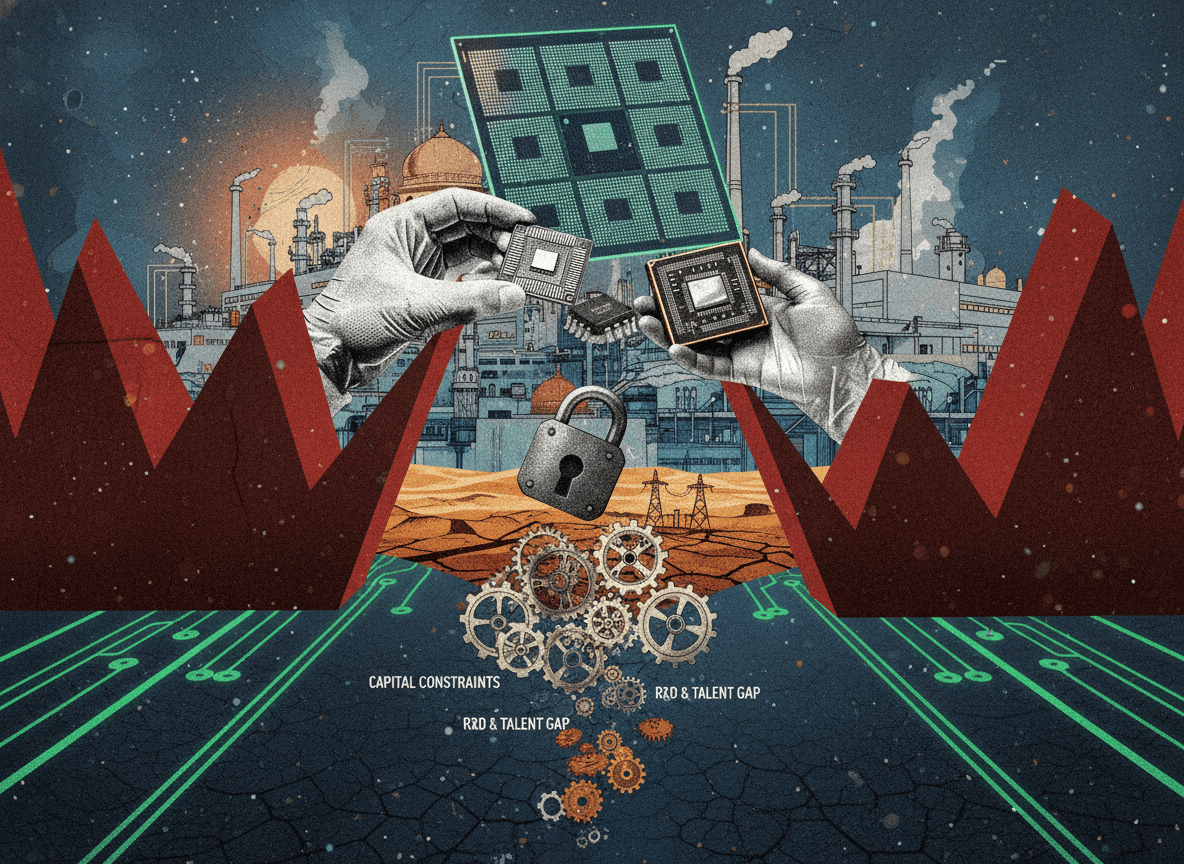
India's semiconductor ambitions face hurdles.
India’s ambition to become a semiconductor hub, potentially a $155 billion market by 2031, faces significant challenges despite strong policy support and increasing investment. A recent Inc42 report highlights that geopolitical shifts and the need for supply chain diversification are driving India’s semiconductor push.
The India Semiconductor Mission has committed approximately ₹76,000 Cr in incentives, aiming to support fabrication projects and reduce chip design costs. Over $15 billion has been committed across the semiconductor value chain, including projects like the Tata-PSMC fabrication plant and Micron’s ATMP facility.
However, the report points out structural constraints that could hinder India’s progress. One key bottleneck is capital. The semiconductor industry is capital-intensive, requiring substantial upfront investment and long gestation periods. India’s investment ecosystem, traditionally favoring faster-return sectors like consumer internet and SaaS, may not be aligned with the needs of deeptech semiconductor ventures.
While the government aims to manufacture AI-grade chips, much of the current investment is directed towards PMICs (Power Management Integrated Circuits) and SiC (Silicon Carbide) semiconductors, essential for EVs and consumer electronics. This mismatch between investment focus and future semiconductor technology could limit India’s competitiveness.
R&D spending in India is also a concern, standing at around 0.6% of GDP, significantly lower than China’s 2.4% and the USA’s 3.4%. To compete effectively, India needs to scale its R&D spending to over $100 billion annually by 2030.
Talent is another paradoxical challenge. Despite producing 2-3 million STEM graduates annually and accounting for about 20% of the global semiconductor design workforce, there is a shortage of specialized, high-end research talent. Advanced chip development requires expertise in materials science, lithography, and high-performance computing, skills that remain limited domestically.
Infrastructure and natural resources pose further challenges. Semiconductor manufacturing is resource-intensive, particularly in terms of ultra-pure water, reliable power, and specialized chemicals and materials. India faces gaps in all three areas, with a high dependence on imported materials, chemicals, and equipment, exposing the ecosystem to global supply shocks.
Addressing these constraints is crucial for India to capitalize on its semiconductor opportunity and become a significant player in the global market.
About the Author